
What are the Montessori Golden Beads
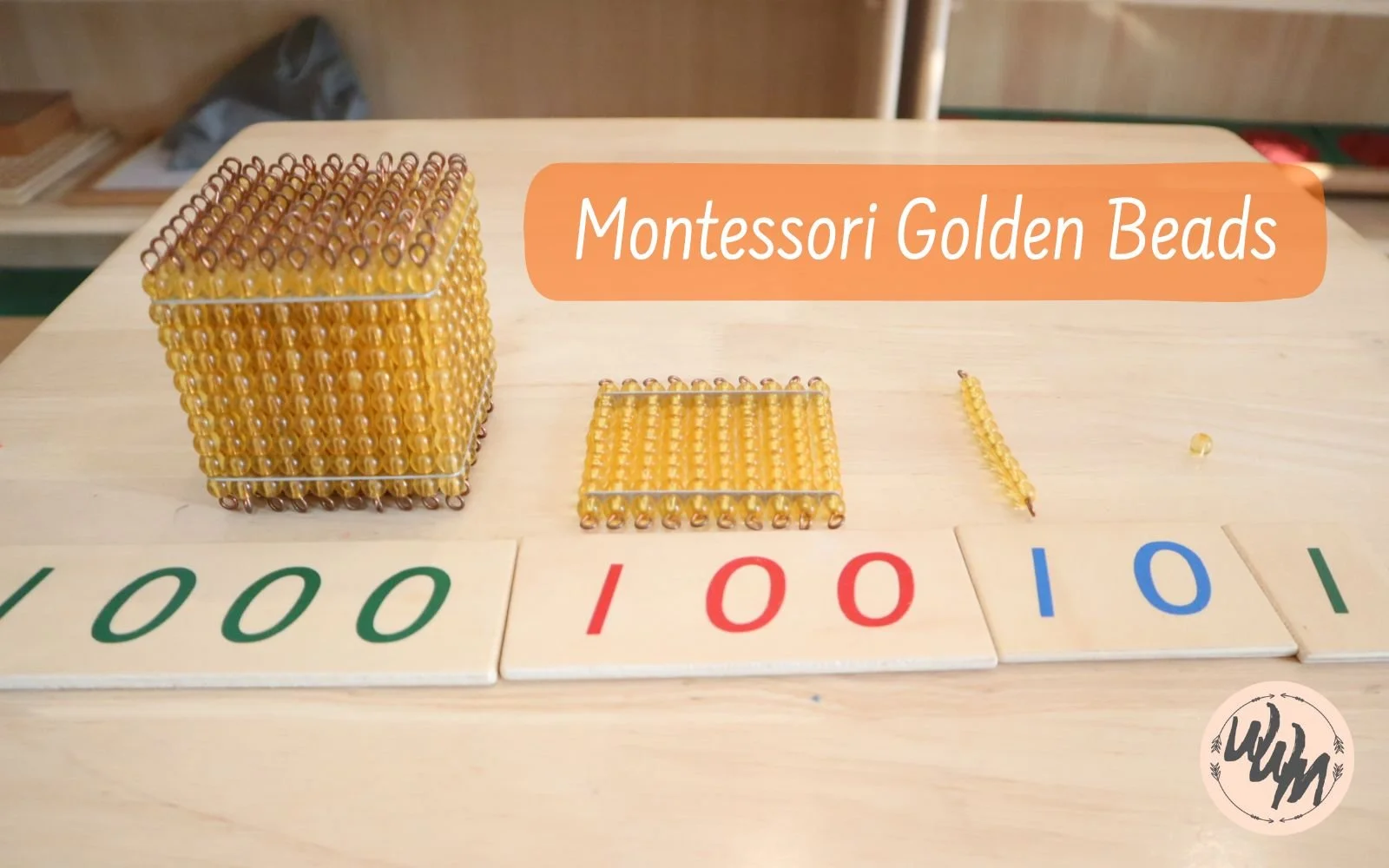
The Montessori ‘Golden Beads’ are one of the most iconic and brilliant materials used in Montessori math. At first glance, they look simple—gold-coloured units, bars, squares, and cubes neatly arranged in a tray. But what they represent is far more powerful: a concrete, tactile way for children to understand place value, the decimal system, and the foundation of all later arithmetic.
See the Golden Beads in action in the classroom here.
In an age where so much learning happens on screens, the Golden Beads offer something refreshingly real.
Children touch math. They see numbers take shape. They feel the difference between 10 and 100, or 1,000 and 10,000. And because of this, math becomes something natural—not abstract or intimidating.
What Are Montessori Golden Beads?
The Golden Beads are a physical representation of the decimal system:
Single unit bead = 1
Bar of 10 beads = 10
Square of 100 beads = 100
Cube of 1,000 beads = 1,000
With these four simple components, children can build, exchange, add, subtract, multiply, and divide. Most importantly, they learn why numbers behave the way they do.
Why the Golden Beads Matter
Many math struggles stem from children trying to understand symbolic concepts too early. The Montessori method flips this: children begin with something real, something they can hold. By manipulating Golden Beads, they understand that:
Ten ones make a ten
Ten tens make a hundred
Ten hundreds make a thousand
This hands-on experience builds an intuitive understanding of place value long before written equations appear. When the abstract symbols eventually arrive, they simply make sense.
Key Benefits of Using Golden Beads
While Montessori classrooms use these materials daily, parents and homeschoolers increasingly bring Golden Beads home because they:
Make place value concrete and memorable
Build confidence in early math
Support independent learning through self-correction
Encourage logical thinking and sequencing
Help children visualize mathematical operations
Whether a child is adding 2,000 + 3,000 with real thousand cubes, or exchanging ten tens for one hundred square, the physical act reinforces understanding.
How Children Learn With Golden Beads
1. Introduction to Quantity
Children begin by exploring the materials freely—feeling the weight difference between one bead and the thousand cube. Interest drives learning here.
2. Symbol Cards
Next comes the link between quantity and symbol. Children match bead quantities to number cards such as 1, 10, 100, and 1000.
3. Building Numbers
A child can literally build 3,462 using beads. This makes the idea of multi-digit numbers surprisingly simple and intuitive.
4. Operations
Once children understand quantity, the Golden Beads become a tool for all four operations:
Addition by combining quantities
Subtraction through taking away
Multiplication by repeated addition
Division by sharing bead quantities
The exchange process—swapping ten tens for a hundred—visually and physically demonstrates regrouping.
Golden Beads at Home
Parents often wonder, “Do I need a full Montessori classroom?” Absolutely not. Even a small set of Golden Beads can transform math learning at home. Start with simple building exercises and let your child lead the exploration. Short, joyful sessions are better than long, structured lessons.
Why This Material Still Matters Today
In a world filled with fast-paced apps and instant answers, Montessori Golden Beads slow things down in the best possible way. They give children the space to think, to make discoveries, and to build number sense from the ground up.
The result?
Children who not only understand math—but enjoy it.